Miss Moritz’s Horror House
Foire de Liège, Belgium
Conceptual approach to a Haunted House Attraction on the Fairground at the Foire de Liège, based on real horrors in our society today.
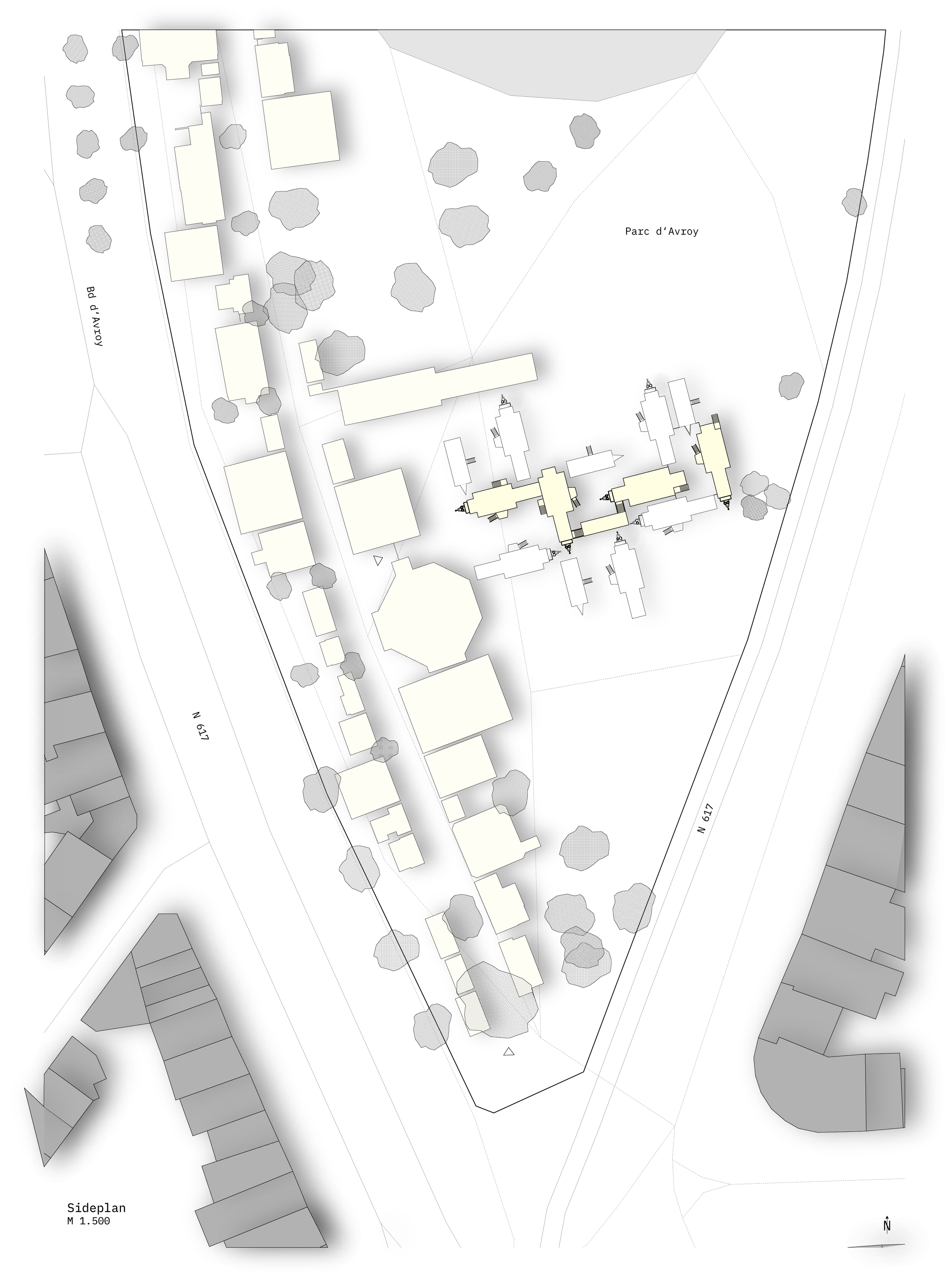
The Foire de Liège, or Foire d’octobre, founded in 1594, is the oldest and the largest Belgian fair still hosted today. With its bustling booths and many attractions, it is a central event for the city of Liège and serves as a significant meeting point for the people of the city. This task was very interesting and different from what I know as an interior designer and challenged my view on conventional architectural projects.
Researching and finding out about the world of funfairs, the long and at times horrifying history, and the meaning they hold in society today made me see this Heterotopia in a new light. Experimenting with the Horror House as one of the fundamental attractions of the fair, I decided to relate it to the “real” horrors we experience and view as such in everyday life. The scenes I created are an indirect reflection on Western society and a mirror of these challenging times we are facing at present.
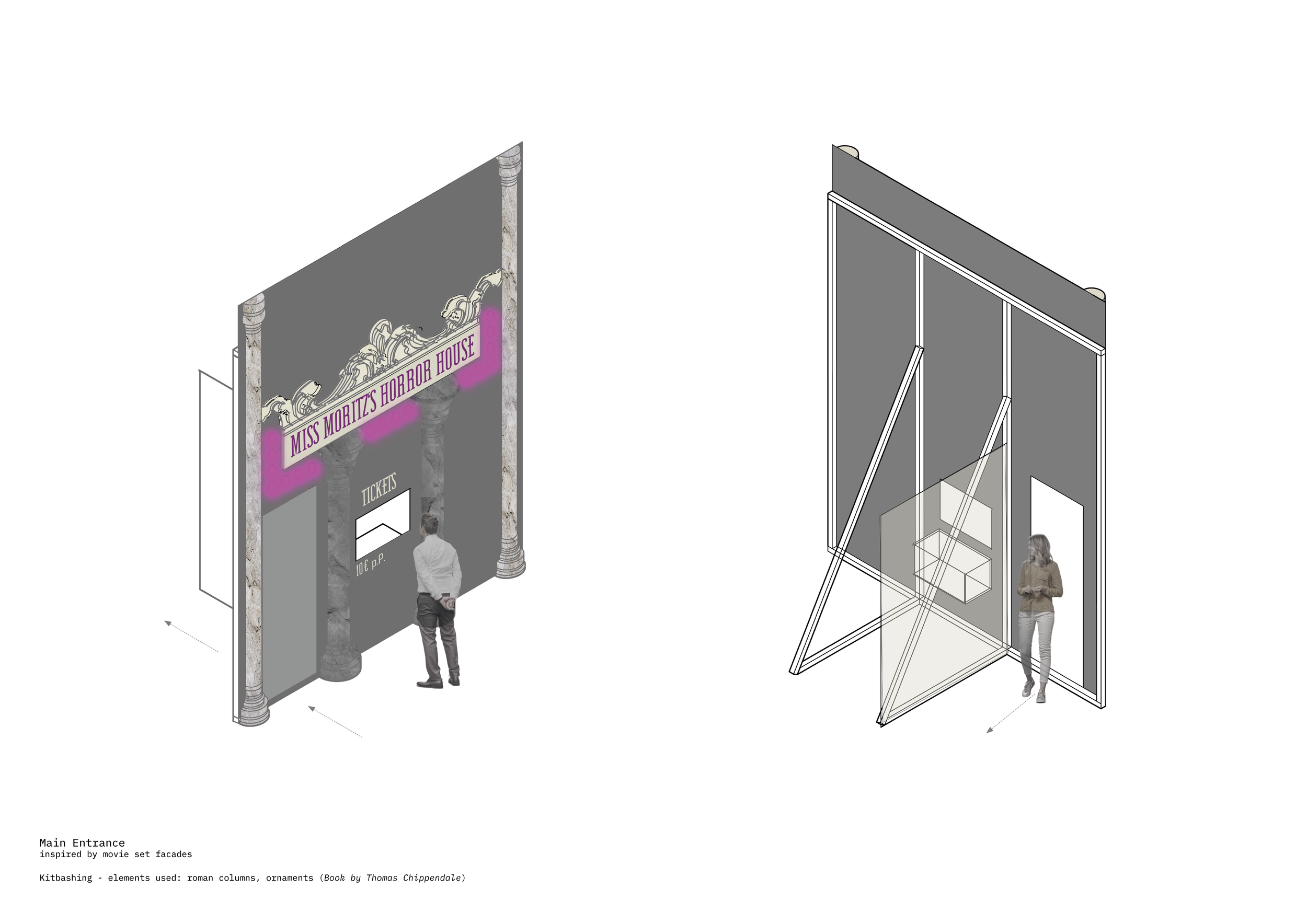
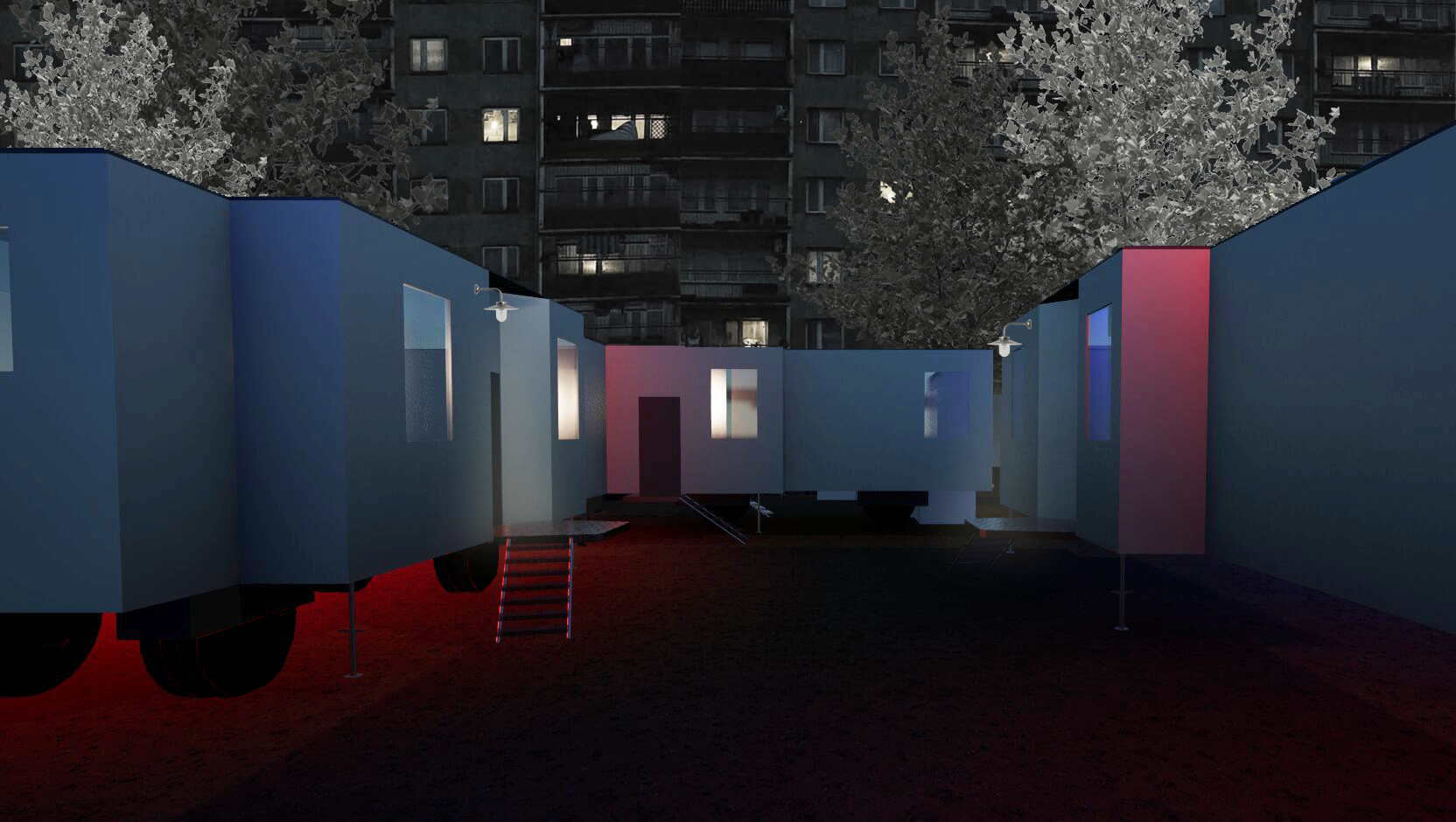
The attraction takes place in the “private” area of the fair. The space that nobody truely things about while walking through the stalls. The stalls we see act as the colorful, flashy facade in front of the private wagons and temporary living space of the people working and living at the fair ground.
We leave the flashing lights behind us and step into the darkness. I developed 6 scenarios/ scenes that relate to different fears and horrors. The six scenarios were chosen after a questionnaire I developed and carried out, questioning people of different genders, ages, and backgrounds.

And with that, I invite you to step into my attraction and take a “ride” through Miss Moritz’s Horror House…

Scene 01 - what happens...
...on the way
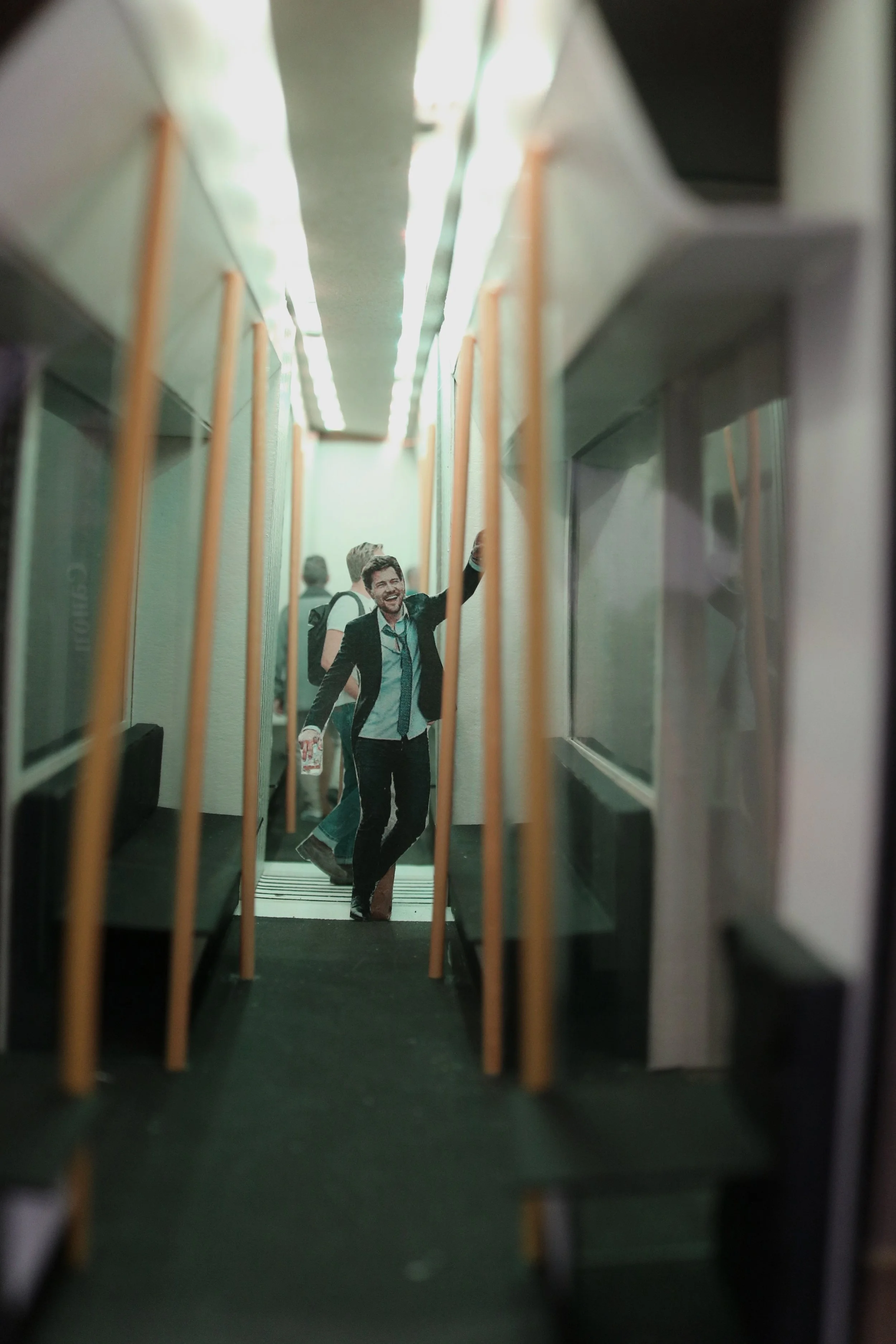
City train wagon. Underground (tunnel). Darkness.
Characters in scene: VISITOR, GROUP OF PEOPLE, STRANGER
The air is stuffy (there is not enough oxygen). The VISITOR enters through one of the train doors and has to sit down in one of the conventional train seats (maybe voice instructs to do so). It smells of alcohol and piss and other unidentifiable smells.
The difference from a “normal“ wagon is that the VISITOR is strapped into the seat - cannot move.
GROUP OF MEN (entering from one of the “train doors“)
Shouting something loudly (celebrating).
Starting to walk towards the VISITOR, looking at her/ him.
STRANGER (improv.)
How are you doing? Do you want a sip?
(offers the beer whilst swaying dangerously and coming really close)
For a few seconds the VISITOR is confronted with him. Can not escape.
STRANGER (improv.)
What is your problem? You are boring! Come on, just one sip.
STRANGER grabs the VISITORS heat from behind and forces them to swollow the liquid.
It seems like the STRANGER wants to start a fight and comes closer and closer. Danger.
Suddenly, another door at the end of the wagon opens up and you can see only darkness.
The VISITOR is forced by the GROUP OF PEOPLE to stand up and walk through the door.
STRANGER
shouting something like: Hey come back! Leaving so soon.
Grabbing the VISITORS arm, touching him/her in some violent way.
Lights go out and the door is closed. One can still hear the shouting of the GROUP OF PEOPLE.
We all experience our “personal“ horror individually. The “individual horror works within (our) cultural context - reflect(s) culturally salient, evolved fears“.
(Clasen, 2017)
Seeing the funfair as a heterotopia in our society, we can clearly state that the attractions mirror societal changes, behaviour and dreams. The term Heterotopia was first introduced by Michel Foucault in 1967 and describes “sites that have the curious property of being in relation with all the other sites“. They are mirrors of our society.
The creator of these attractions possesses a certain decision-making power. The intention of this project is, to create a contemporary mirror of our society and present events which occur in our daily lives.
And so it begins...
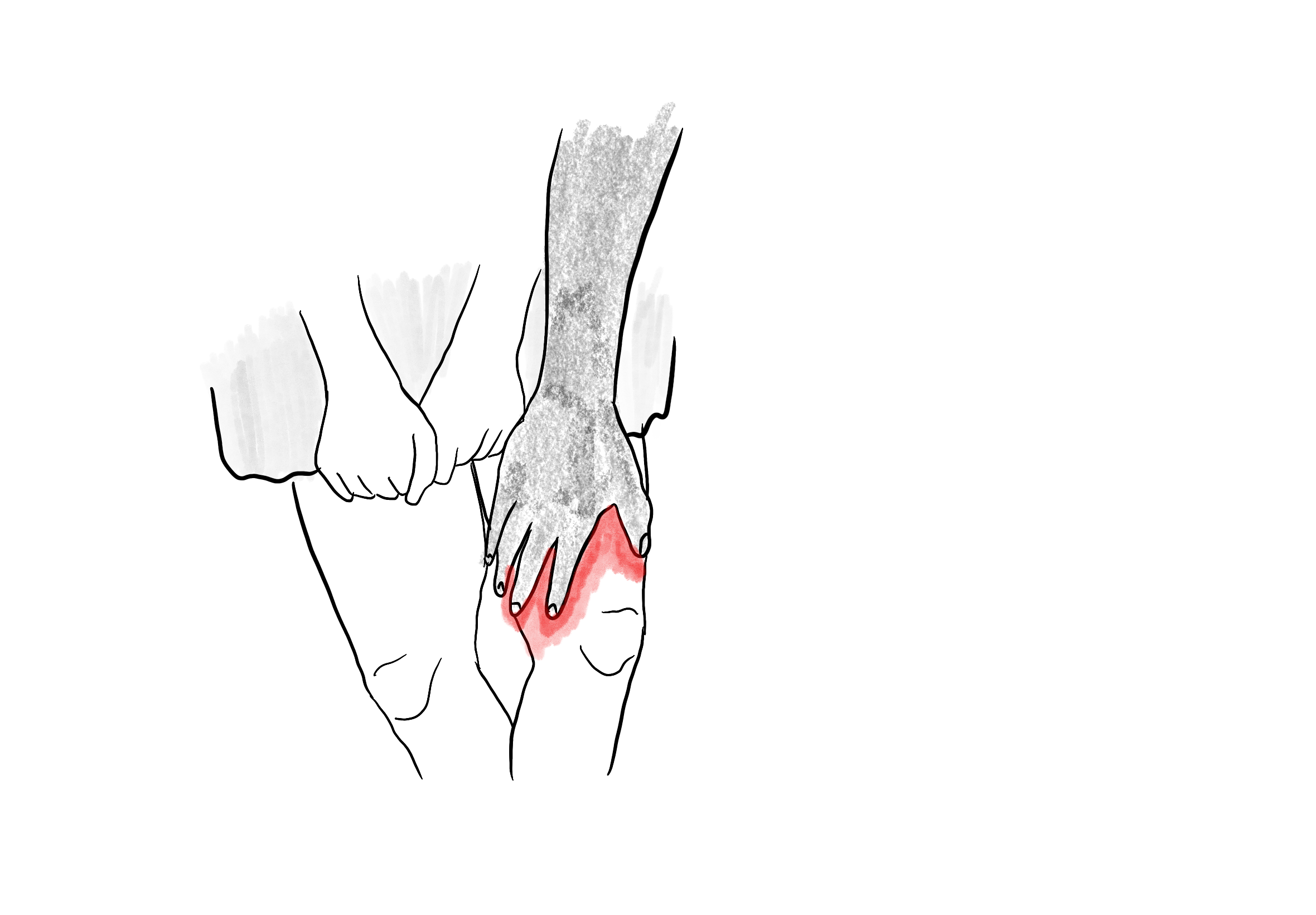

What are we suppose to do? Everything is repeating itself! People only want power, and with that power comes hate and destruction. (something like this)
STRANGER starts crying and screaming and moving around, shaking.
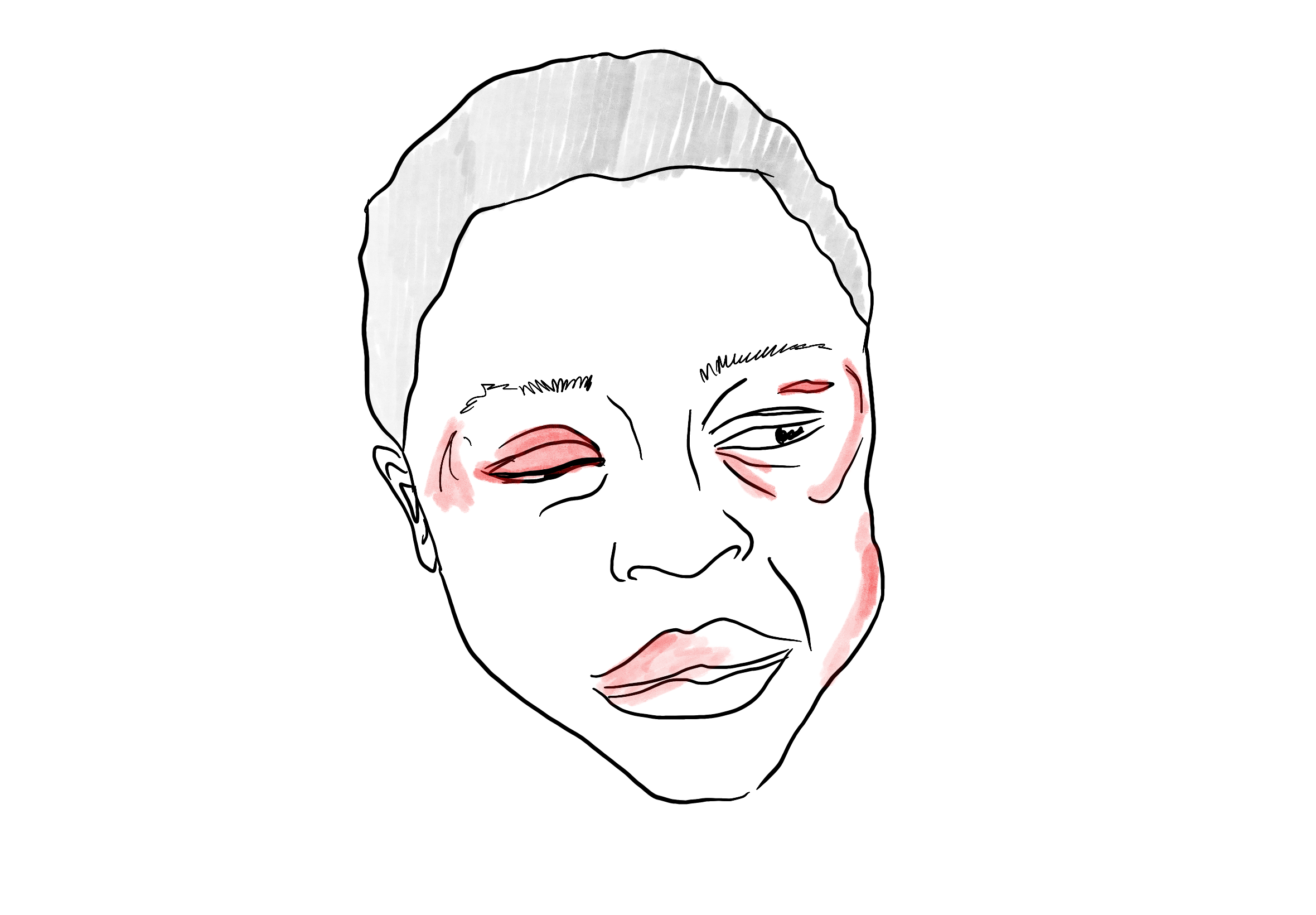
From one to the other moments: stops and looks at VISITOR. The STRANGERS face is beaten up, maybe you can see traces of heavy drug usage.
STRANGER
(whispers) The horror is starting.
STRANGER exists through an opening in the wall.
The VISITOR is forced to move on because of the wall closing in behind him/her. When it seems like the wall is gonna crush him/her and there is no escape an opening to the left appears and the VISITOR can slip through.
In between scenes: VISITOR has to walk down a set of stairs. There is no ceiling which gives the VISITOR the short opportunity to listen to the world around him/her and hear the sounds of the funfair.
Scene 2 - what happens...
... on the street
Dark Alley. Night.
Characters in scene: VISITOR, STRANGER
Walking around the corner the VISITOR feels a cold wind and hears weird noises. Under the light of one street light, he/she can barely see the whole space.
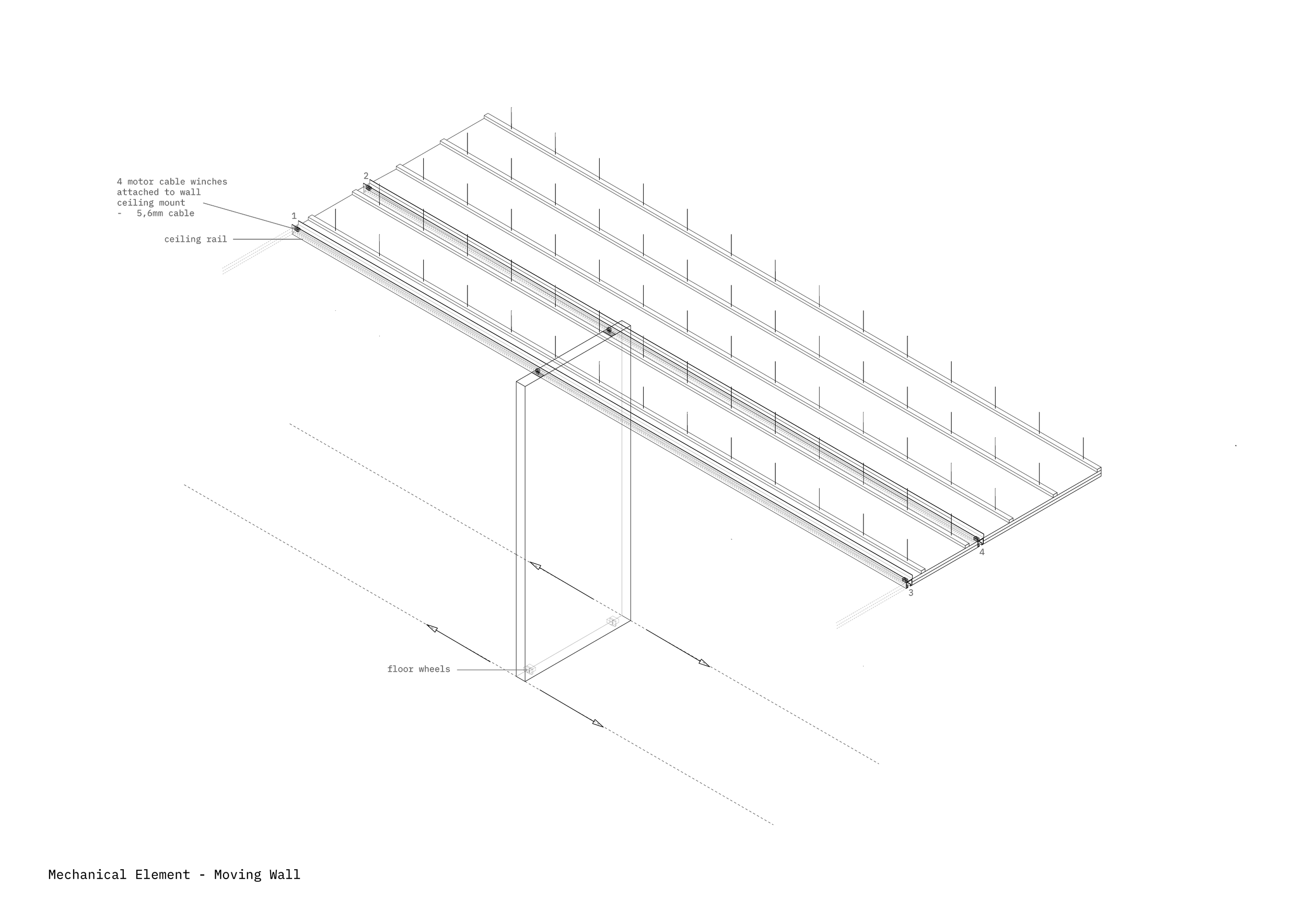
A mechanical wall behind the VISITOR starts moving and he/she is forced to walk further into the alley.
Suddenly a quiet figure appears, the STRANGER, with his/her hood up. The face can not be recognized this way. The STRANGER is limping and walks towards the VISITOR. The wall behind is still moving and closing in.
Right when the STRANGER is infront of the VISITOR. (jumpscare)
STRANGER (improv.)
(Starts screeming and talking nonsense. About the world, wars, terrorism etc. Looks like a mentally ill person, brabbeling on.)

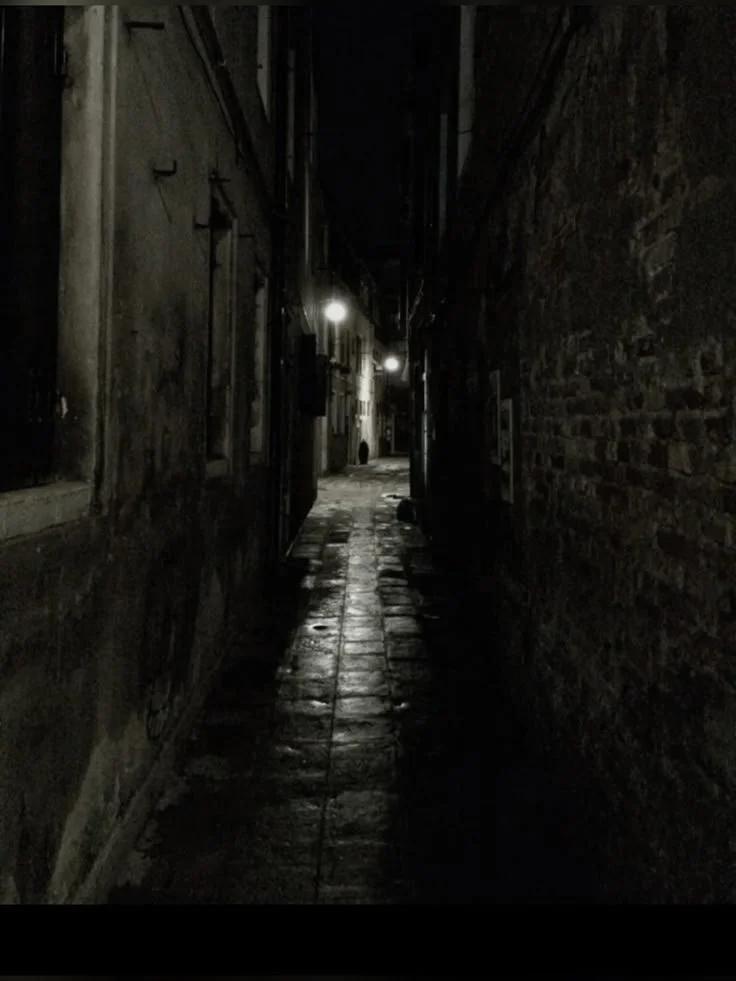
The horror genre often plays with “the suggestion and depiction (verbal or visual) of threatening agents“, which creates a internal fear in the watcher, but they don‘t know where exactly it comes from and what is triggering it.
(Clasen, 2017)
By placing this suggestion in a realistic environment, everyday life memories are triggered and we would feel the same as if we actually were in said situation.
There is a suggestion of someone or something from the outside, from the off, which could appear anytime/ anywhere. This “usually unidentified force [...] sows the seeds of chaos and destruction within the boundaries of a home“ and our daily experiences.
(Paquet-Deyris, 2012)

Scene 3 - what happens...
... underground
Tunnel, Underground. Day or Night (could be both).
Characters in scene: VISITOR
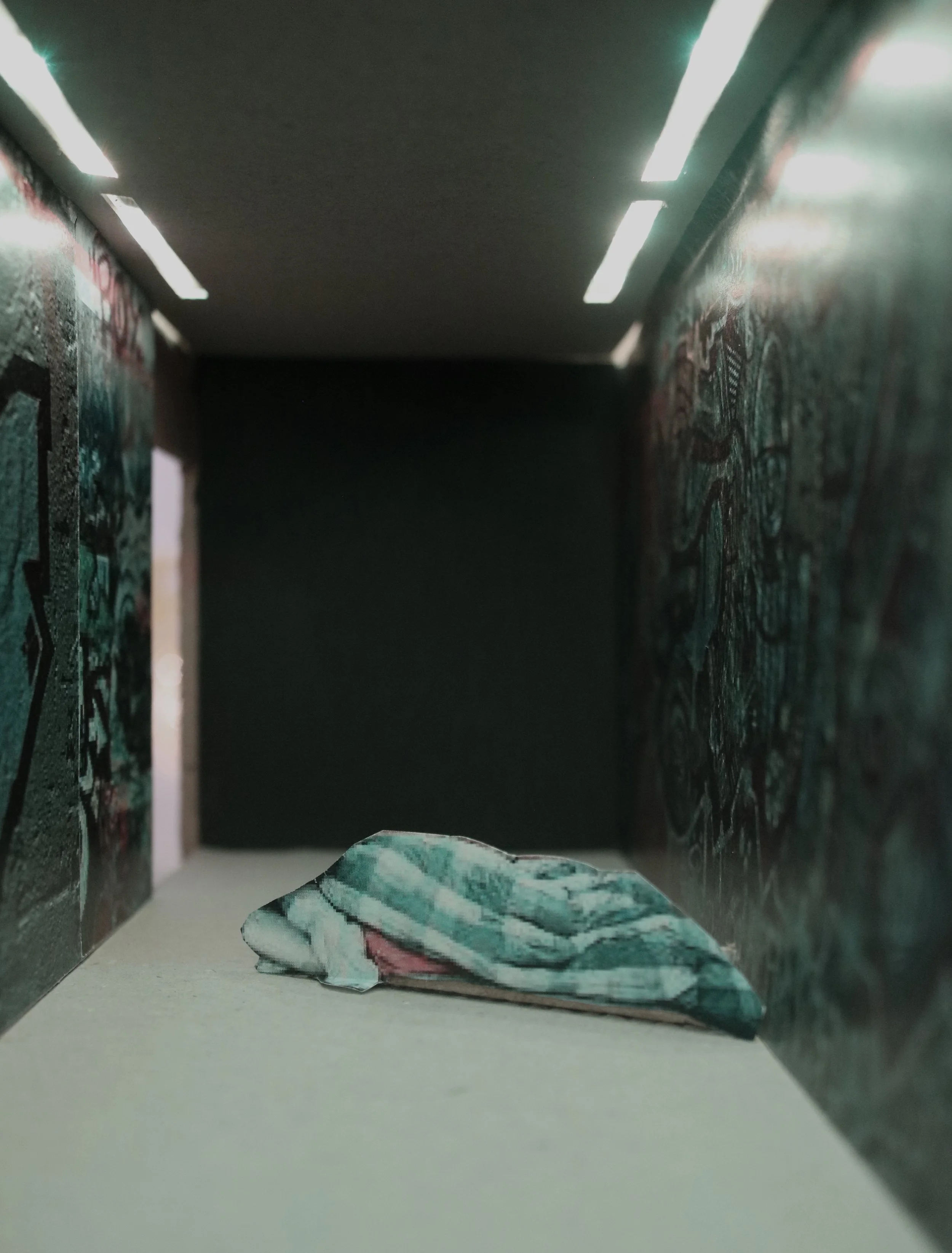
The tunnel is dark and clammy. Sounds of echoing noises (maybe shouts) can be heard, but nothing/ no one is visible.
The only visible thing is a bundle lying on the floor in the middle. It looks like a human body, totally still. Everything becomes quite. The VISITOR has to step over the body to get to the next exit.
VISITOR walks toward the light source.
While approaching the bundle on the floor objects become visible. A syringe, a lighter with a spoon next to it and some other personal belongings are scattered around the bundle.
VISITOR has to step over the bundle. And walks on.
At the end of the narrow tunnel, stairs become visible and the VISITOR has to climb them to get out of this room.
In between scenes: VISITOR climbs up the stairs and steps onto the next scene.


Scene 4 - what happens...
... at daytime
Street crossing. Day.
Characters in scene: VISITOR
The atmosphere is nearly post-apocalyptic. Silence. No birds, no sounds of the world around.
Objects are splattered across the street. Images of war/ terror attacks come to mind.
A stroller is lying on the ground, next to it a toy. There are several paramedic thermal blankets, which reflect the light through their colours. Police tape is surrounding the scene. Flowers and candles are set as an altar (as if remembering the victims) next to the toy.
The VISITOR has to walk throught the middle of everything.
Sounds of protests start playing. A song starts playing: “Der Kaiser von Atlantis: Komm, Tod, du unser werter Gast“ by Viktor Ullmann.
The only open, unlocked door leads to a small backroom. It looks like the attraction is over, or the VISITOR has walked into the private, backstage area.
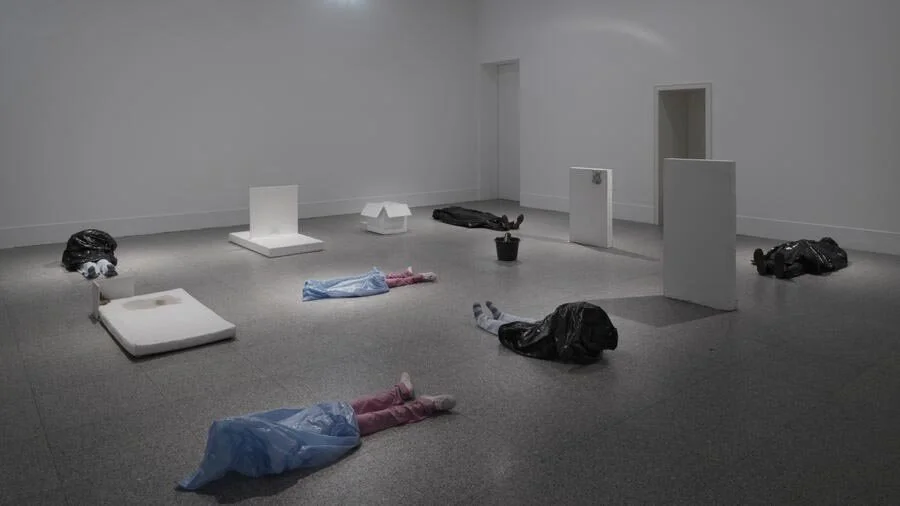
The german sculptor, photographer and filmmaker Gregor Schneider was a big inspiration for this project. In his project “haus u r“ he works in his former family home. He creates rooms inside of rooms, remakes them or makes some of them disappear. His room installations are made in a modular way so that they can be easily rebuild.
Schneider searches for the hidden reality inside existing spaces. He plays with deception and suggestion and creates spaces which always leave you with a weird stomach knot that you can not define.
He works inbetween extinction and preservation which totally confuses our perception of a room and we start to question “places that overall seem safe and their security in the first place...“
(Backes, Art Dialog)
Scene 5 - what happens...
... after the illusion
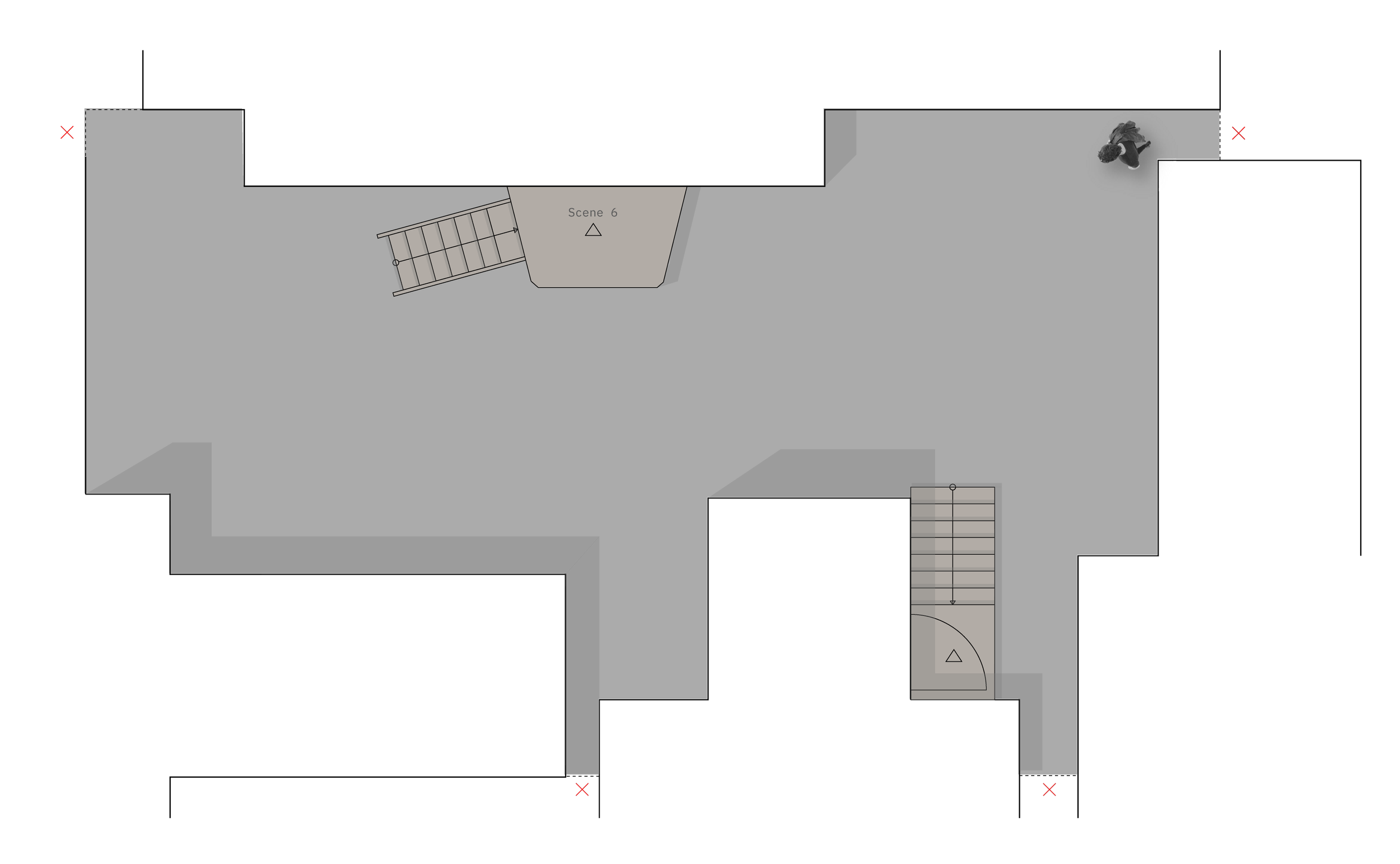
Outside yard. Night funfair atmosphere.
Characters in scene: VISITOR, STRANGER
STRANGER enters the scene from the “Off“. He/ She seems drunk or under the influence of drugs.
STRANGER comes up really closely to VISITOR and starts talking.
STRANGER (improv.)
Do you have any change to spare?
When the VISITOR doesn‘t have anything to give him/her, he/she gets upset and starts pulling out a knife, screaming at the VISITOR.
STRANGER (improv.)
Give me your wallet and every valuable thing you have on you!
STRANGER starts crying and screaming, going crazy.
After some time, STRANGER starts cramping up, falling to the floor. It seems like the STRANGER is in a lot of pain. He/She crawls away and disappears behind one of the caravans.
The path is cut off by several fences between the private caravans, therefore the VISITOR can not follow the STRANGER.
A child crying/ a scream comes from the inside of another caravan on the opposite side of the yard. The front door is half open, so the VISITOR (hopefully) walks into the cravan to see if he/she can help.
Building personal resilience in specific scenarios could “help us develop and maintain coping skills - skills in handling our own negative emotions.“
(Clasen, 2017)
By experiencing this attraction we go through five stages that help us build up our resilience.
1 emotion control
2 impulse control
3 causal analysis
4 self-efficacy belief
5 empathy
Every path to creating personal boundaries always is individual.
“We have to set boundaries in a boundless world.“
(Hoppe; Ezzeldin, 2022)

Scene 6 - what happens...
... in private
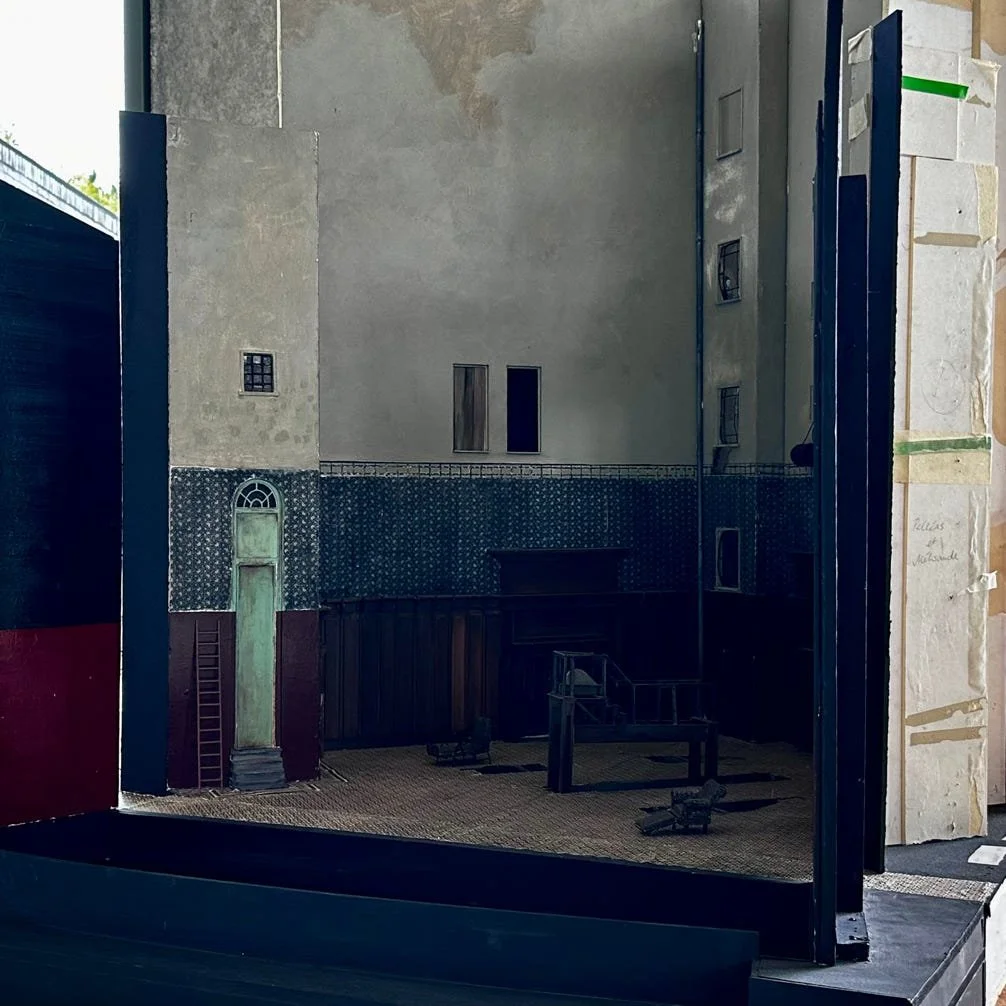
Childrens Bedroom. Private space in caravan.
Characters in scene: VISITOR, OWNER (male)
The door closes after VISITOR enters the bedroom.
First, there is no one in the room. Everything looks normal at first glance but something is off. There are no personal pictures and stuff is lying on the floor. It looks really messy and neglected.
The OWNER enters the room. He smells like alcohol and looks very dirty. His clothes have a lot of grease stains and he has the typical “trailorpark“-look. Low hanging Jeans, white dirty tank top. Face is puffy from alcohol and exhaustion.
OWNER
What are you doing here? This is private property?
(getting angrier) Get out of here!
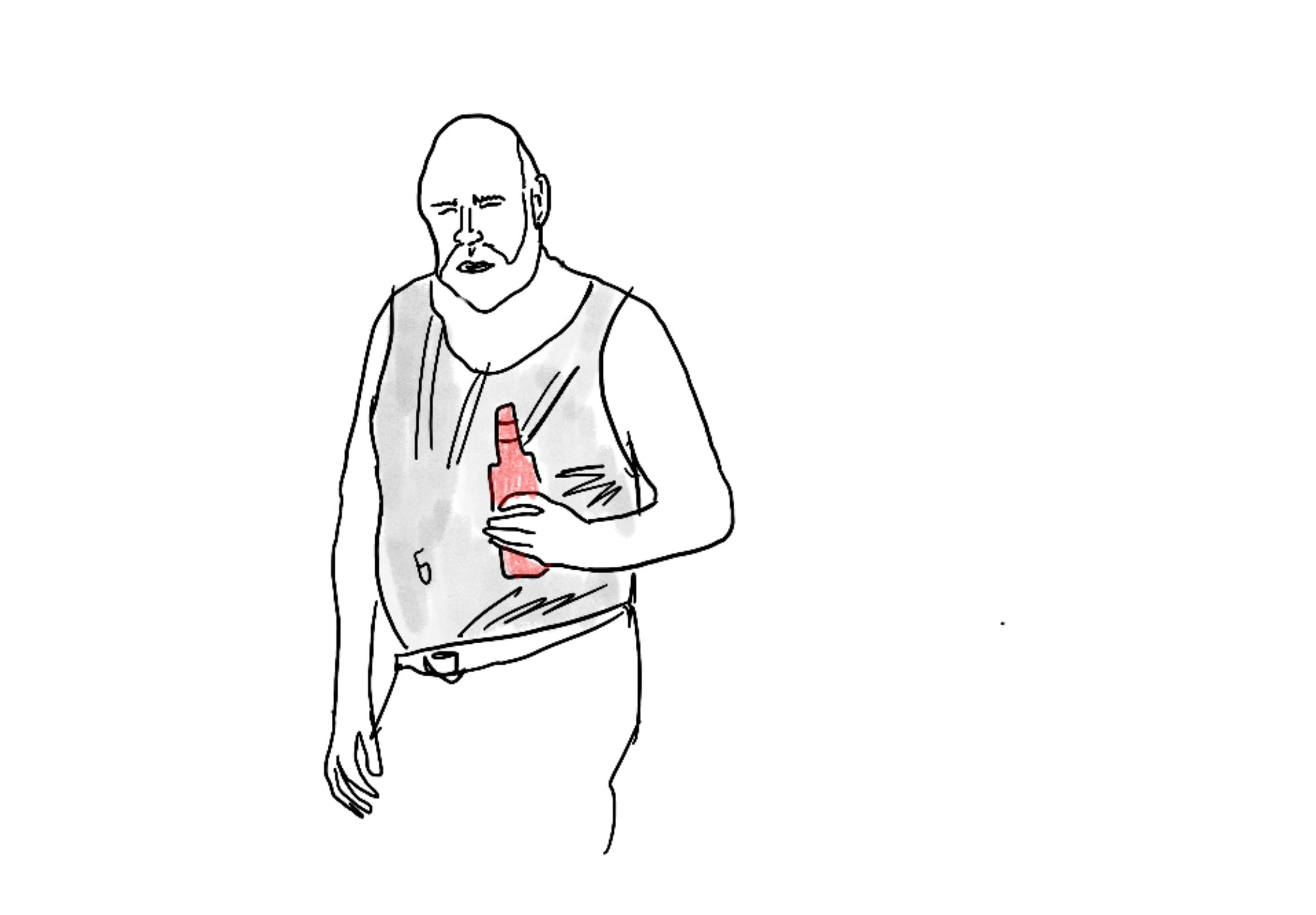
OWNER steps towards VISITOR.
OWNER
Do I need to get violent to get you out of here?
OWNER is now infront of VISITORS face, very close, invating the personal space.
He grabs the VISITORS arm and starts pulling him/ her to the back door, still screaming and spitting in her/his face.
The VISITOR is being dragged out of the back door and ends up in the dark between the private caravans.
There is no clear exit-sign or way out. The “exit“ is to walk through the private area and...
... find your own way back into reality.
reference list
Backes, Elcke. Gregor Schneider - On the trails of extinction and preservation [Gregor Schneider - Auf den Spuren von Auslöschung und Bewahrung] website: Elcke Backes Art Dialog.
Clasen, Mathias. (2017). Evolution, Cognition, and Horror: A Précis of Why Horror Seduces.
Foucault, Michel. (1967) Of Other Spaces: Utopias and Heterotopias. Architecture/ Mouvement/ Continuité, 1984.
Hoppe, Annette. Ezzeldin, Alexander. (2022). What helps our resilience, creating borders or crossing borders? [Was Hilft uns unserer Resilienz, Grenzen setzen oder Grenzen überschreiten?] Brandenburgische Technische Universität Cottbus-Senftenberg, Fachgebiet Arbeitswissenschaft/Arbeitspsychologie.
LeDoux, Joseph E. (1996). The Emotional Brain: The Mysterious Underpinnings of Emotional Life.
Nesse, Randolph M. (2006).“The Smoke Detector Princile.“ Annals of the New York Academy of Science 935 (1):75-85. doi:10.1111/j.1749-6632.2001.tb03472.x. (as cited in Clasen, 2017)
Simon & Schuster. (as cited in Clasen, 2017)